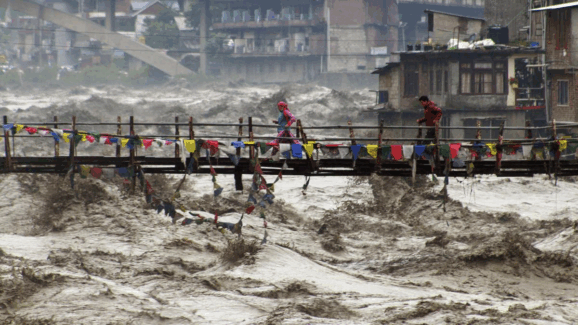
The Bhagirathi river flowed gently alongside the village, its rhythm steady and comforting. Pilgrims on their way to Gangotri often paused here, enchanted by the village’s stillness.
Dharali, tucked away in Uttarkashi district of Uttarakhand, was Himalayas in its vibrant reality.
For locals, Dharali wasn’t just a village, a picture of peace and beauty, it was a way of life, perfectly aligning with nature.
Life moved slowly, nestled along the banks of the Ganga (Bhagirathi) with lush apple orchards that painted the valley red each autumn, stretching across slopes, wooden houses built in Himalayan style, and snow-capped peaks covering the horizon.
The Turning Point – came with the floods
The harmony changed suddenly. The floodwaters tore through Dharali village, unleashing deluges of water, entering the Bhagirathi and leaving behind a trail of debris and mud. The sound of the river, once soothing, now carried fear.
For the villagers, Dharali after the floods was no longer the paradise it had been.
As Swami Vivekananda observed that “give and take is the law of nature.”
It rightly goes with the Mother Nature too, which has always been a force that gives and takes. It builds mountains and sustains life. But when disrupted, it also brings destruction. Across India, we are witnessing how nature is changing entire landscapes and communities.
DEVBHOOMI UTTARAKHAND
Dharali: A Himalayan Paradise Built and Changed by Nature
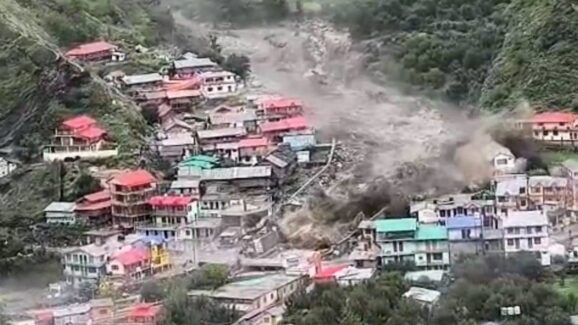
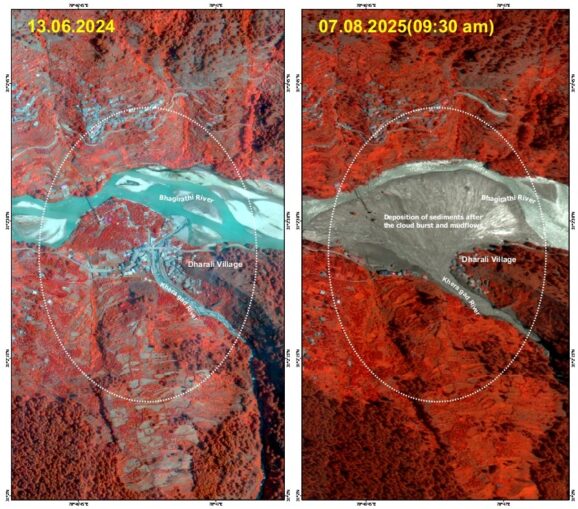
On the 5th of August 2025, around 1:45 p.m. local time, a sudden deluge of water in Dharali and Harsil villages, in Uttarkashi district, occurred, triggered by intense rainfall.
The District Magistrate confirmed four deaths and a week later, released a list of 42 missing people. Nine army personnel were unaccounted for. The landslide occurred around four kilometres from Army’s Harsil camp, prompting a swift response by 150 personnel from the IBEX Brigade. Tonnes of debris from the Kheer Ganga River was spread over the Dharali market, comprising 65 hotels, over 30 resorts and homestays and numerous shops. Everything was razed to the ground under 25 to 30 feet and in some places even 40 feet of debris.
Even the connecting road was affected by landslides, so a pressing concern was the disruption of transport routes, too.
The disaster inflicted extensive damage on apple orchards along with the cultivation of kidney beans (rajma). A survey conducted by the Agriculture Department revealed that agricultural land spanning at least 7.30 hectares in Uttarkashi district has been affected, of which 3.10 hectares lie within the Dharali region. The flood also caused substantial losses to livestock owners, triggering a broader livelihood crisis.
The primary cause of the flash flood is still unknown. However, experts speculate that it could have been a rock and ice avalanche.
Navin Juyal, a senior geologist with over three decades of work in Uttarakhand, suggested that the calamity emanated from a cirque or hanging glacier (shallow cavities in which ice accumulates).
The IMD characterised “extremely heavy rainfall” from August 3-5 as a probable cause, but not a cloudburst (a cloudburst is a more extreme form of rainfall, resulting from a build-up of moisture forming large cumulonimbus clouds that suddenly release all their water).
HIMACHAL PRADESH – IN THE LAP OF HIMALAYAS
Himachal Pradesh continues to reel under the impact of the ongoing monsoon season.
Since the onset of monsoon in the State on June 20, Himachal Pradesh has suffered losses to the tune of ₹2,394 crore.
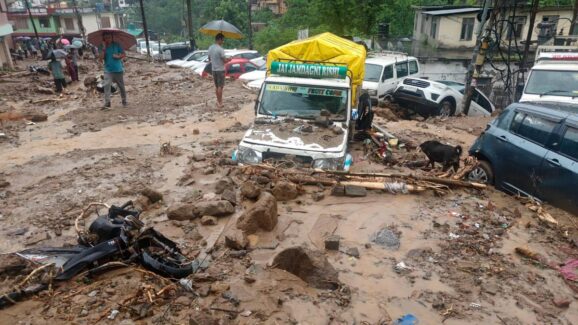
The State has witnessed 77 flash floods, 41 cloudbursts and 81 major landslides and at least 156 people have died in rain-related incidents, with 524 roads, including two national highways blocked, 1,230 electricity distribution transformers disrupted and 416 water supply schemes rendered non-functional as of August 25, according to the SEOC (State Emergency Operation Centre).
Hundreds of cargo vehicles were stranded due to landslides and Beas River, destroying stretches of the Chandigarh-Manali national highway, leading to a shut down from Pandoh to Aut in Mandi. Mobile connectivity was also snapped in the majority of Chamba district and Manali.
On August 31, three people died in Shimla district owing to continuous heavy rains in the region, which also led to damaging property and disruption in essential services.
JAMMU & KASHMIR: THE NATURE’S PARADISE
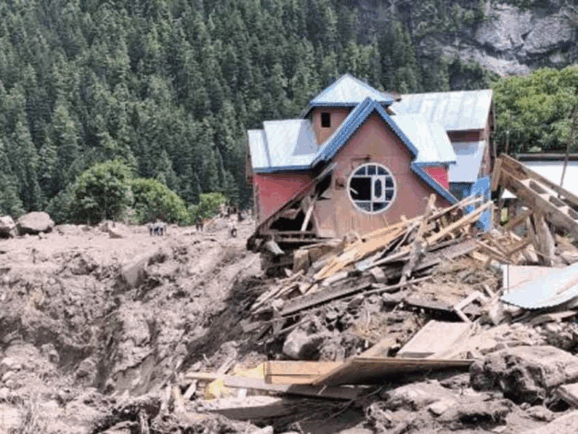
Pounding rain battered Jammu and Kashmir, leaving highways cut off, villages abandoned and hundreds stranded, with landslides in Reasi and cloudbursts in Ramban.
31 people were killed and several went missing after a landslide struck near the Vaishno Devi shrine in Jammu’s Katra. The path turned into a scene of devastation as portions of the mountain crumbled away.
The Kashmir flood was caused by intense rain, mismanagement, unplanned urbanization, and lack of preparedness.
DEVASTATION ACROSS COUNTRY
In August 2025, India witnessed widespread flooding and waterlogging, from the Himalayan north to urban hubs and rural plains and the devastation continues.
In Punjab, massive floods submerged over a thousand villages, displaced 1.5 million people and drowned farmland.
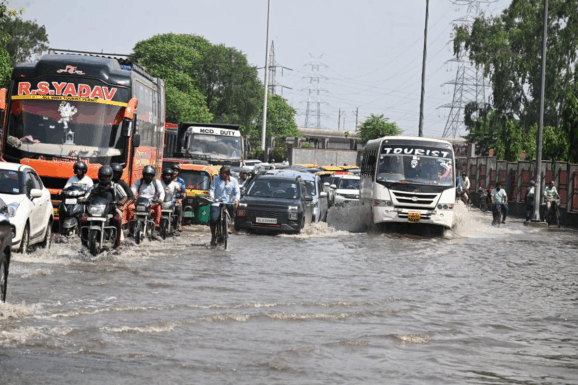
Mumbai and Patna faced gridlocked traffic, submerged roads and stalled transport. Dausa in Rajasthan was cut off due to flooded lanes and cracked roads. Delhi-NCR suffered traffic and problem in commuting while Himalayan regions faced deadly landslides and pilgrim route disruptions amid record rainfall, which continues even now.
Collectively, these events underscore the monsoon’s intensified fury, chronic infrastructure shortcomings and the urgent need for resilient urban planning and disaster preparedness.
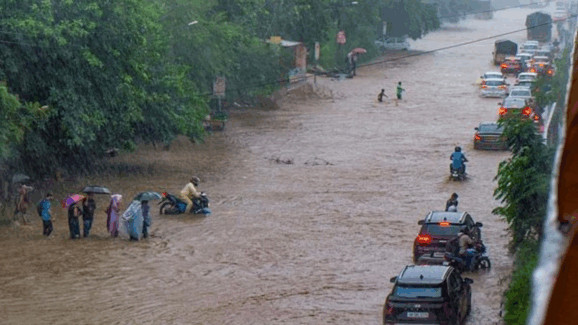
Gurugram grappled with waterlogging, with traffic coming to a standstill. Several city roads and underpasses remained inundated while villages came under water when the Aravali dam near the Kadarpur village in the city’s Sector 63 A area got severely damaged.
In adjoining Delhi, people living in the Yamuna floodplains moved hearth and home as the water of the river inundated their dwellings.
CONCLUSION
India’s landforms are not the villains. They are the same lifelines as they always were. It is us, who have made their survival difficult. The statement, every action has an equal and opposite reaction, can be applied here easily.
The Himalayas gave us sacred perennial rivers, pilgrimage sites, acting as a natural climatic barrier. Tourism flourishes along mountain slopes.
In Himachal and Uttarakhand, the government allowed encroachments around the rivers, in the name of travel and tourism.
However, reckless building of dams, four lane highways, hydro projects, illegal construction and deforestation have destabilized slopes. Siltation in Himalayan rivers has increased due to deforestation. Warming temperatures melt glaciers faster, forming unstable lakes that burst without warning, making GLOFs (Glacial Lake Outburst Floods) a recurring climate disaster.
In the absence of a management policy, the debris from road and construction activity is mostly thrown into rivers, clogging them.